
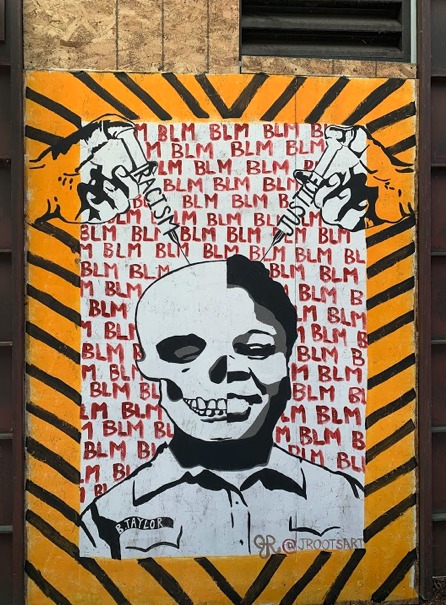
This is a piece dedicated to justice for Breonna Taylor. The mural addresses the fact that racism is injected into our society even if there is “caution tape” in the way. Racism ultimately leads to death. Justice would lead to life if we could break the caution tape and inject that into our society.”
Jordan Roots, “Caution, Racism Kills,” George Floyd & Anti-Racist Street Art , accessed August 2, 2023, https://georgefloydstreetart.omeka.net/items/show/86.
Sometimes racism kills quickly and violently – with whips, nooses and lynchings, chokeholds, carotid restraints, and shootings of unarmed Black people by police. Other times death by racism is – “death by 1000 cuts”– a slow, long, and drawn-out process. – akin to the brutal lingchi method of execution.
This is precisely what happens in Alzheimer’s Disease. In the initial stages, abnormal proteins accumulate inconspicuously in the background of any given neuron, silently corroding the mind as well as neural architecture. Eventually, years later, the protein reaches a critical threshold, setting off a neural chain reaction that leads to actual clinical and neurological symptoms. The first clinical symptoms may be subtle changes in memory, which then progress to distortions of cherished moments, personal history, and the loss of recognition of loved ones. In the final stages, even one’s own identity may be lost.
Jessica, an AD caregiver, eloquently captures the profound impact of this disease: “To be a caregiver of someone living with Alzheimer’s is that you watch your loved one die every day.”
However, the story does not end there. As racism can further compound this already challenging process in a multitude of ways. According to Carl V. Harris, chief diversity, equity, and inclusion officer at the Alzheimer’s Association, “Racism is trauma that can lead to increased stress…[and] can result in negative biological changes such as inflammation, a known risk factor for cognitive difficulties including dementia.” Although racism may not be the direct cause of dementia, its cumulative impact can be likened to the lingchi method, where a series of seemingly inconsequential injuries culminate in a fatal wound.
Just as the lingchi method inflicts numerous small cuts that eventually lead to death, the insidious effects of racism inflicts numerous small cuts on cognitive health over time. Structural racism, manifesting through factors, such as the cut of lower socioeconomic status, the slice of subpar early-life education, and the slash of a limited access to vital resources such as nutritious food and adequate healthcare, can contribute to inequities. These disparities, both individually and cumulatively impact the biological processes that elevate the risk of dementia over a lifetime.
Each act of discrimination and inequality (i.e. 1 of the thousand cuts), be it overt or subtle, adds to the burden carried by marginalized communities. These ongoing experiences of racism generate chronic stress, which, in turn, triggers a cascade of physiological responses that harm the body and brain. The resulting inflammation, oxidative stress, and other biological changes further exacerbate the risk of cognitive decline and dementia.
In short, Alzheimer’s disease is undoubtedly a devastating disease. Even more so for Black and other marginalized communities.
Today, an estimated 6.7 million Americans age 65 and older are living with Alzheimer’s Disease, and by 2060, it is projected this number will double, reaching an estimated 14 million individuals who suffer from Alzheimer’s Disease and related dementias. The toll is especially heavy for African Americans as accumulating evidence reveals a disturbing trend
Such a pronounced disparity urges us to ask an important question: Why does such a stark disparity exist?
The answer—racism. While race is a social construct, its impact reverberates through biology, leaving devastating consequences in its wake. Nowhere is this more apparent than in Alzheimer’s Disease, where the very essence of one’s humanity—one’s memories, cognition, and neurological well-being—is under siege.
A look at the biology of Alzheimer’s Disease paints a grim picture.
Enter the concept of allostatic load—an embodiment of the cumulative physiological wear and tear inflicted by chronic exposure to stressors (i.e. physical stressors-exertion, heat/cold, illness and psychological stressors-anxiety, fear, humiliation, etc.). According to the weathering hypothesis, chronic exposure to the multifaceted stressors associated with systemic racism—social, political, and economic disadvantages (i.e. redlining and racialized residential segregation, mass incarceration and police violence, unequal employment and unequal wealth distribution) —can significantly contribute to this allostatic load, with profound implications for both physical and mental health outcomes.
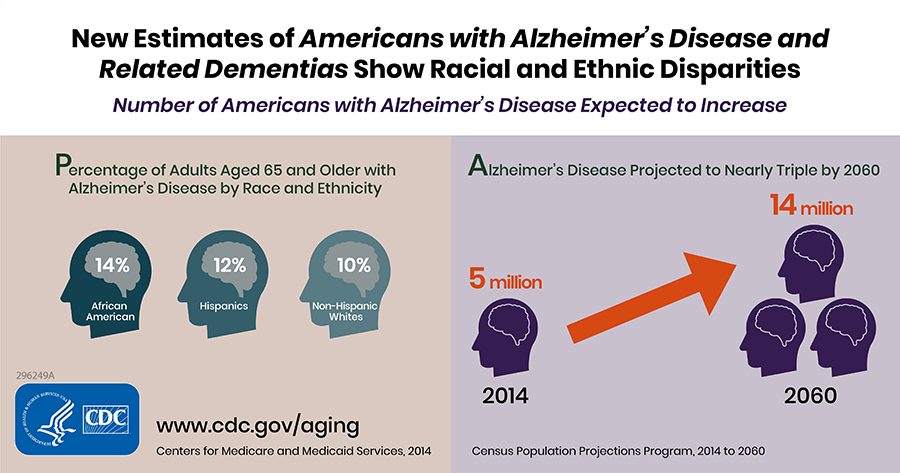
Today, an estimated 6.7 million Americans age 65 and older are living with Alzheimer’s Disease, and by 2060, it is projected this number will double, reaching an estimated 14 million individuals who suffer from Alzheimer’s Disease and related dementias.”
In recent years, studies have found that: experiences of racism (i.e. being treated unfairly due to race in jobs, housing, police, courts, school, medical care) are associated with worse cognition in African Americans. Moreover, these racial stressors may accelerate the biological aging process in African Americans over their lifetime, leaving an indelible mark —increased prevalence of white matter lesions(markers of cerebrovascular disease that are associated with cognitive decline and Alzheimer’s disease) —on their brains.
Racism’s reach extends beyond the body and the brain; It infiltrates the very diagnostic and treatment strategies employed to combat Alzheimer’s Disease.
Instead of delivering a single fatal blow, Lingchi employed a cruel torture method designed to inflict a slow death by means of numerous seemingly inconsequential injuries that, when combined, resulted in a lethal wound. Similarly, it may take years for us to fully grasp how small, disregarded acts of systemic racism ultimately culminated in a devastating impact on the brain health of an entire community. This realization places us at a critical moment in our history, where we face a crucial choice. We can either take decisive action to eradicate racism in Alzheimer’s disease, or we can sit idle, as the brains of some of the most valuable and vulnerable members of our community continue to literally bleed to death. By seizing this moment and acting now, we have the power to break the cycle of suffering and injustice, paving the way towards a future where the impact of racism in Alzheimer’s disease is diminished, and equity reigns supreme in the realm of neurology.
Racism: prejudice, discrimination, or antagonism directed against a person or people on the basis of their membership in particular racial or ethnic group, typically one that is a minority or marginalized
Structural racism: Inequalities rooted in the systemwide operation of a society that excludes substantial numbers of members of particular groups from significant participation in social institutions
Systemic racism: Inequalities rooted in the systemwide operation of a society that excludes substantial numbers of members of particular groups from significant participation in social institutions
Institutional racism: refers to the policies and practices within and across institutions that, intentionally or not, produces outcomes that chronically favor, or put a racial group at a disadvantage
Anti-black racism: term used to specifically describe the unique discrimination, violence and harms imposed on and impacting Black people specifically.
Source: Boston University Community Service Center and Race Forward
The mission of the Boston Congress of Public Health Thought Leadership for Public Health Fellowship (BCPH Fellowship) seeks to:
It is guided by an overall vision to provide a platform, training, and support network for the next generation of public health thought leaders and public scholars to explore and grow their voice.