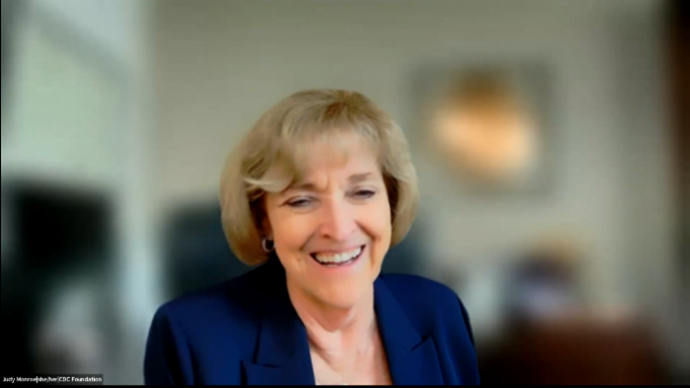
Recently, I had a unique opportunity to interview Dr. Judy Monroe, President and CEO of the CDC Foundation, as part of the Global Health Corps Leadership Academy series.
A formidable and accomplished leader – whose experience has spanned local, state, regional, national, and global contexts – Dr. Monroe shared candid reflections and responses to my questions about all things health and leadership related.
We had such a fun conversation, covering a range of topics from her greatest leadership achievements to promoting equity in the workplace to what she does for fun. But what stood out to me most was her humility, her approachability, and her willingness to engage with an audience of emerging health and equity leaders to guide them on their journeys.
It made me realize that a key toward unlocking progress in health is diverse and authentic leadership. That’s a type of leadership where leaders know themselves, know their values, and know how to connect with their team. That’s a type of leadership that we don’t talk enough about.
If I could summarize my top 5 take-aways from the conversation, it would be:
While impossible to include the full transcript of our 90-minute discussion, I’m including some excerpts from our conversation and some key reflections below. I’m grateful to Dr. Monroe for her candor in conversation, and to the Global Health Corps for the opportunity to feature in this conversation.
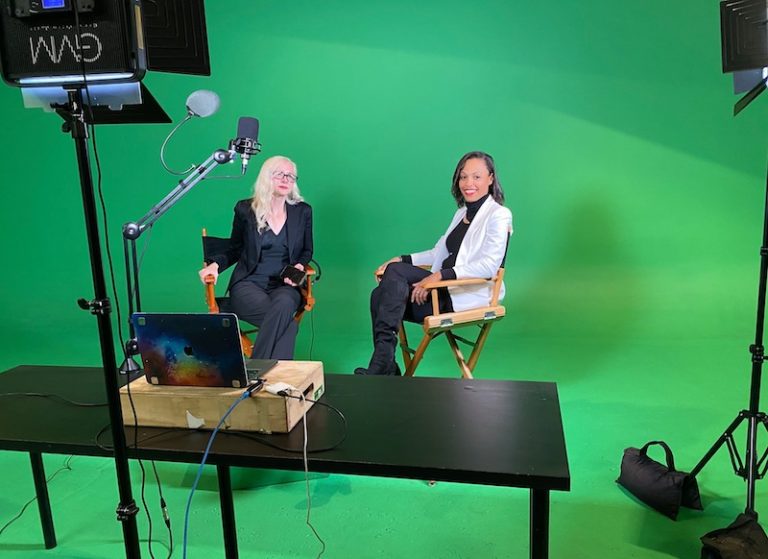
Dr. Yvette Efevbera (moderator) and Dr. Judy Monroe (guest) during the GHC Leadership Academy Fireside Chat
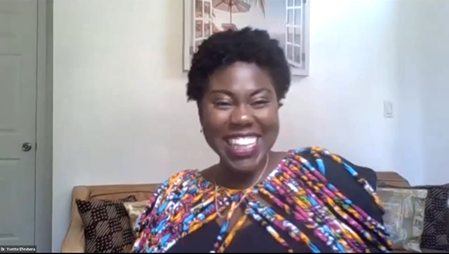
Images © Global Health Corps 2023
Dr. Yvette Efevbera: Well, you know, I have some questions for you! But as someone who grew up in the Midwest, we don’t start by asking people what you do for work, we start by asking where you’re from. So, let’s start there: where are you from, and where do you call home now?
Dr Judy Monroe: I grew up in the Midwest. I grew up in Dayton, Ohio. My family was from Kentucky, so I have a lot of roots there. I now live in Atlanta, Georgia after I moved here to join the CDC [U.S. Centers for Disease Control and Prevention].
Dr. Yvette: As someone who grew up in Ohio, whose family comes from Kentucky, how on earth did you end up on this public health journey that you’ve been on?
Dr. Judy: It has been a public health journey! My starting point, as a young child and probably one of my earliest memories, my mother had polio during the polio epidemic before I was born. So, I was one of the children that lined up at school to get the polio vaccine [when it became available]. I just remember my mother was so happy, so relieved, that her children could be vaccinated. So that instilled a real curiosity in me about public health, about diseases, about hardship. I had an interest in science and medicine, and I did become a physician and practiced in a variety of settings, but there came a point where I started to grow really frustrated that we were seeing an increase in diabetes in children, an increase in hypertension…I was getting frustrated with what was happening in the world. Then about that time, Governor Daniels of Indiana tapped me on the shoulder and asked me if I would be the state health officer. And that was my transition from medicine to public health.
Dr. Yvette: Wow, really incredible journey! As I was listening, I was thinking about how important those early life experiences and community exposures are. For me, I grew up in Michigan. My family is also Nigerian. We would go back and forth, and that was what opened my eyes initially. And then my mom did a sabbatical and was at the CDC for a couple of years, and for the first time, I realized there was a community, a space, that focuses on these issues for communities that I’m a part of around the world. So, incredible to hear just a little bit of your journey.
I’m curious how you define a great leader?
Dr. Judy: Leadership is a journey! You continue to learn every day on that journey. And you’re only leading if folks are following. That’s key because we don’t accomplish big things by ourselves; we accomplish really big things through teams. That’s been a real lesson for me.
I will share with you a definition of leadership that really has spoken to me, that I learned at the Harvard Kennedy School of Government when I became a new state health officer. There’s an author, Marty Linsky, who’s written “Leadership on the Line,” and he defines leadership as “disappointing your friends at a pace they can tolerate,” which is a really interesting [definition]. But when you are leading and you have to impact change, not everybody wants that change, so somebody’s going to be disappointed in hard decisions that leaders need to make.
Dr. Monroe shared some of her incredible leadership experiences, from her time as state health officer in Indiana to responding to the Zika virus, Ebola outbreak, and COVID-19.
Dr. Yvette: The first thought I had, Judy, is how political health is. You get into thinking “oh I want to change the world,” but I have to figure how to navigate an organization with people politics, and in your case, actual governmental politics.
Dr. Judy: You’ve got to learn the lay of land for sure.
Dr. Yvette: That piece on trust and community that you bring up, you know, I was doing some of my doctoral research years ago in Guinea, in West Africa, after Ebola. I remember wanting to interview women, and I had been encouraged by my mentor, Dr. Paul Farmer, to go and live and immerse myself in the environment, and I tried. And I remember, at first, people wouldn’t talk to me. People were suspicious. People were concerned. I saw a lot of those same lessons in my U.S. community during COVID-19 as well. So those pieces on trust and that community has power and community has the answer resonates so much with me. Also, it’s incredible to hear you as a leader of a major foundation stating that! This is a big deal, to have those kinds of values!
Dr. Judy: And you learn so much. Everyone you meet has so much to teach you.
Dr. Yvette: On a personal note, I’m a woman. You are a woman. And in the U.S., we have this notion of being able to do it all sometimes. You’ve got to have your home life. You’ve got to have your work life. You’ve got to be a leader as well and do this and do that. I’d love to know: what does “balance” look like for you, and how do you grapple with that?
Dr. Judy: Well, there’s a lot to unpack there. First, at a very high level, I will tell you that on any given day, I might not be balanced, but if I look back over a year or a longer period of time, I’ve actually been very balanced. I might put in long hours and have an intensely busy week, but I play as hard as I work. It’s my counterbalance. I was as fortunate to have a partner who was as happy to do dishes and change diapers, so I was fortunate to have someone who would share all aspects of life. So, I made a choice when the kids were little, and I deliberately took a job that was easy for me to leave in middle of the day to go to the school play or the basketball games. I think you balance your life through phases, and you can balance your life over time. But, in any given moment, you might be totally out of balance.
Dr. Yvette: That’s so comforting! That’s a helpful and a healthy perspective.
You know, Judy, a little bit about my background in gender equality, global health, and public health space. Diversity, equity, and inclusion has been a really important part of my own professional journey for more than a decade now. So, I have to ask you, as a white woman who is at the helm of a major public health foundation that has influence, how do you think about ensuring marginalized or historically excluded communities – like those I belong to, for example – are really at the forefront of decision making and have a seat at the table as well?
Dr. Judy: When I joined the Foundation, I started to diversify our board, so the leadership at the board level is far more diverse today than it was in 2016. Then, I began diversifying the executive team. And then, in turn, those executive leaders diversify our staff. Today, we have a very diverse staff.
During our COVID-19 response, we hired a Chief Health Equity and Strategy Officer, Dr. Lauren Smith. Lauren works with our senior leaders to develop and drive strategic efforts to embed health equity across all of the Foundation’s activities. In addition, Lauren’s team conducts webinars and trainings for our staff educating them on equity, diversity, and inclusion. So, you have to be very intentional.
We do a lot with our community organizations, and we recently created a youth council. We want to hear the voices of youth from a lot of different communities. We’re really concerned about climate and health. We need to hear from the communities being impacted. So regardless of what the topic is, whether it’s women’s health or the topical areas you’ve been working on that are dear to your heart, those are really important to us.
Every time someone has given me a leadership role, I’m pretty sure my team has looked a lot more diverse than it did when I started. I’m a big believer that we’re so much more intelligent together. Diversity is such a strength if you unleash the talent and unleash the wisdom and the experience. I’ve always been a believer in that.
Dr. Yvette: I’m wondering for emerging leaders, who maybe aren’t at the top of an organization, if you have any concrete recommendations for what one can do in a way that doesn’t feel overly burdensome when you’re not at the helm of power.
Dr. Judy: First of all, your voices and your insights are so important. One of the things that I’ve done since I was at CDC is to be able to communicate with all staff at every level. So, if you get into an organization that you don’t have access to leadership, push for it! Ask the right questions! Try to push to make sure your voice [is heard]!
*Transcript has been edited for clarity and brevity.
The mission of the Boston Congress of Public Health Thought Leadership for Public Health Fellowship (BCPH Fellowship) seeks to:
It is guided by an overall vision to provide a platform, training, and support network for the next generation of public health thought leaders and public scholars to explore and grow their voice.